


What Is an Employer of Record (EOR)?
An Employer of Record (EOR) is a third-party organization that becomes the legal employer of a worker on behalf of a client company. The EOR manages employment contracts, payroll, social contributions, and statutory compliance in the worker’s country. The client company directs the work. This enables international hiring without establishing a local legal entity.
How an Employer of Record Works?
- An Employer of Record arrangement involves three parties: the worker, the EOR, and the client company. The EOR signs the employment contract with the worker under the laws of the worker’s country and is registered with local tax and social security authorities as the legal employer. The client company enters into a separate commercial services agreement with the EOR and directs the worker’s day-to-day activities, performance standards, and work output. The EOR invoices the client company for the gross employment cost plus a service fee.
- The EOR model solves a fundamental challenge in international hiring: employing someone in a country where the hiring company has no legal entity. Without a local entity, a company cannot legally run payroll, remit social contributions, or sign an employment contract that is enforceable under local labor law. The EOR’s existing local employer registration removes this obstacle, allowing the client company to begin employing someone in a new country within days rather than the months required to establish a foreign subsidiary.
How important is the legal employer listed on your employment contract?
The legal employer listed on your employment contract is important because it determines which entity is legally responsible for your employment rights, payroll obligations, and compliance with local labor laws. In an Employer of Record (EOR) arrangement, the EOR is the official legal employer registered with government and regulatory authorities in the worker’s country.
As the legal employer, the EOR is responsible for issuing the employment contract, ensuring compliance with statutory requirements, processing payroll, managing tax and social security contributions, and providing legally required benefits and protections. The client company manages the worker’s daily activities and performance but does not become the legal employer.
This distinction provides clarity for all parties. The worker knows which entity is responsible for their employment rights, while the client company can hire internationally without establishing a local legal entity or directly assuming employment obligations in that jurisdiction.
How Does an Employer of Record Handle Payroll, Taxes, and Social Insurance Compliance?
The EOR processes payroll for the worker each pay period, calculating gross pay, applying all statutory deductions including income tax withholding and social insurance contributions, generating a locally compliant payslip, and disbursing net pay to the worker’s bank account. The EOR remits all employer and employee social contributions and tax withholdings to the relevant authorities by the applicable statutory deadlines. The client company receives a single consolidated invoice rather than managing multiple local registrations and filing obligations across different authorities.
In Switzerland, this includes registering with the cantonal compensation office for AHV/IV/EO and ALV contributions, affiliating with a BVG pension fund, enrolling with a SUVA-approved accident insurer, and registering with the cantonal tax authority for Quellensteuer withholding for eligible foreign national workers. Each of these registrations has its own initial setup process, ongoing reporting obligations, and annual reconciliation requirements that the EOR manages entirely.
Benefits, Leave, and Statutory Entitlements
The EOR is responsible for providing all statutory employee entitlements in the worker’s country. This includes minimum paid annual leave (four weeks per year in Switzerland under Article 329a of the Code of Obligations), sick pay, parental leave, occupational accident insurance, and any mandatory supplementary benefits required by applicable collective agreements. When a worker takes statutory leave, the EOR manages the administrative process, claims any statutory reimbursements from the relevant authority, and ensures continued employment protections throughout the leave period.
How Does the Dual-Party Structure Work in an Employer of Record Arrangement?
Despite the EOR being the legal employer, the client company retains full operational direction of the worker. The client sets objectives, allocates tasks, determines working methods within legal limits, and manages day-to-day performance. This dual structure is legally recognized in most jurisdictions, provided the EOR genuinely fulfils its employer obligations rather than functioning as a passive administrative conduit. If an authority finds that the EOR is a sham arrangement designed to circumvent local employment law, the client company may be deemed the true employer, exposing it to all the liabilities the arrangement was intended to avoid.
EOR Cost Formulas and Break-Even Analysis
Understanding the cost structure of an EOR arrangement is essential for finance teams evaluating international hiring options. The following formulas allow businesses to calculate the total cost of engaging a worker through an EOR and to determine at what headcount level establishing a local entity becomes more cost-effective.
EOR Cost Formulas
-
Formula 1: Total Monthly EOR Cost per Worker
| Total Monthly EOR Cost = Gross Monthly Salary + Employer Social Contributions + 13th Month Accrual + EOR Service Fee
Employer social contributions in Switzerland = AHV/IV/EO 5.30% + ALV 1.10% + BVG employer share (est. 8%) + SUVA/BU + FAK (est. 3.5%) = approximately 18% to 20% of gross. EOR service fee typically ranges from 8% to 15% of gross salary depending on country and provider. Example: CHF 10,000 gross + CHF 1,900 contributions + CHF 833 (13th month accrual) + CHF 1,000 fee = CHF 13,733 per month. |
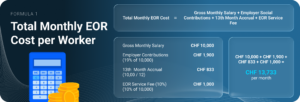
Estimates the total monthly cost of employing a worker through an Employer of Record (EOR). It includes the employee’s gross salary, mandatory employer-paid social contributions, a monthly accrual for the 13th-month salary (where applicable), and the EOR’s service fee for managing payroll, compliance, and employment administration.
-
Formula 2: EOR Total Employment Cost Multiplier
| EOR Cost Multiplier = (Gross Salary + Employer Contributions + 13th Month) / Gross Salary
This ratio shows how much the gross salary is multiplied by employer obligations before the EOR fee. In Switzerland: (10,000 + 1,900 + 833) / 10,000 = 1.27x. Adding the EOR fee (est. 10%): 1.37x. Every CHF 1 of gross salary costs approximately CHF 1.37 in total EOR spend for a Swiss worker. |
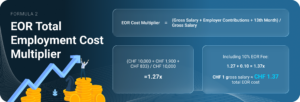
It shows how much the employer’s total employment cost exceeds the employee’s gross salary before the EOR service fee. It helps estimate the true cost of employing a worker by accounting for mandatory employer contributions and 13th-month salary accrual. Including the EOR service fee provides the full cost multiplier for budgeting and cost comparisons.
-
Formula 3: Annual EOR Cost vs. Entity Cost
| Annual EOR Cost = (Gross Annual Salary x EOR Cost Multiplier) + EOR Annual Service Fee Annual Entity Cost = Gross Annual Salary x Employment Cost Multiplier + Fixed Entity Overhead
Fixed entity overhead includes legal setup (amortized), annual accounting and audit, registered office, directorship, and internal admin costs. In Switzerland, fixed entity overhead typically ranges from CHF 30,000 to CHF 50,000 per year for a minimal entity. Use this formula to determine which model is cheaper at a given headcount. |

Compares the annual cost of employing workers through an Employer of Record (EOR) versus hiring through a locally established legal entity. While the EOR model includes service fees, the entity model adds fixed operating costs such as company setup, accounting, compliance, and administration. It helps identify the more cost-effective option as employee headcount grows.
-
Formula 4: EOR vs. Entity Break-Even Headcount
| Break-Even Headcount = Fixed Annual Entity Overhead / (EOR Fee per Employee per Year)
At this headcount, the cost of the EOR fee equals the fixed overhead of maintaining a local entity. Below this number, the EOR is cheaper. Above it, the entity is cheaper. Example: Fixed entity overhead CHF 41,000 / EOR fee per employee CHF 12,000/year = 3.4 employees. Once the Swiss headcount exceeds approximately 10 to 15 employees, entity costs typically become lower per worker than ongoing EOR fees. |
 Estimates the number of employees at which maintaining a local legal entity becomes more cost-effective than using an Employer of Record (EOR). Below the break-even headcount, the EOR is generally the lower-cost option because it avoids fixed entity costs. Above this point, spreading the entity’s fixed overhead across more employees typically makes the entity model more economical.
-
Formula 5: Permanent Establishment Risk Threshold (Indicative)
| PE Risk Increases When: Duration > 12 months AND Workers Generate Revenue Attributable to Client Company
Most Swiss and OECD tax treaty rules apply a 12-month duration test for fixed-place permanent establishment. If EOR workers are engaged in revenue-generating activities (sales, business development, contract execution), the client company’s tax advisers should assess PE risk once the engagement exceeds 6 to 12 months. This is not a precise formula but a risk trigger that should initiate a formal tax review. |

This is not a strict mathematical formula but a risk indicator used in international tax compliance. Under common OECD-aligned tax principles and many Swiss treaty interpretations, sustained activity over time combined with revenue-generating functions can create a “permanent establishment” exposure for the client company. When engagements approach 6–12 months, especially with commercially active roles, it typically triggers a formal tax review to assess whether the client may be deemed to have a taxable presence in that jurisdiction.
EOR vs. Entity Cost Comparison
The table below provides a Year 1 cost comparison between hiring one employee in Switzerland through an Employer of Record (EOR) and employing the same worker through a newly established Swiss legal entity. The comparison assumes a monthly base salary of CHF 10,000 and includes mandatory employer contributions, typical employment-related costs, and the additional administrative expenses associated with each approach. All calculations are based on 2024 Swiss statutory rates and estimated market costs for EOR services and entity maintenance.
| Cost Component (1 employee, CHF 10,000/month base) | Via EOR (Year 1, CHF) | Own Entity (Year 1, CHF) |
| EMPLOYMENT COSTS | ||
| Gross annual salary (12 months) | 120,000 | 120,000 |
| 13th month payment | 10,000 | 10,000 |
| AHV/IV/EO employer (5.30%) | 6,890 | 6,890 |
| ALV employer (1.10%) | 1,430 | 1,430 |
| BVG pension employer share (est. 8%) | 10,400 | 10,400 |
| SUVA + FAK (est. 3.5%) | 4,550 | 4,550 |
| TOTAL EMPLOYMENT COST | 153,270 | 153,270 |
| EOR SERVICE FEE vs. ENTITY OVERHEAD | ||
| EOR service fee (est. 8-12% of gross salary) | 10,800 | |
| Legal entity setup (legal, notary, registration) | 12,000 | |
| Annual accounting, audit, and tax compliance | 15,000 | |
| Registered office and directorship | 8,000 | |
| HR admin and payroll system internal costs | 6,000 | |
| TOTAL OVERHEAD | 10,800 | 41,000 |
| TOTAL YEAR 1 COST | 164,070 | 194,270 |
| Cost difference (EOR saving in Year 1) | CHF 30,200 lower | |
| Break-even point (EOR vs. own entity) | Approximately 10-15 employees | |
Note: EOR service fee estimated at 9% of gross annual salary (CHF 120,000 x 9% = CHF 10,800). Entity overhead figures are indicative midpoints for a minimal Swiss GmbH or branch with no local full-time staff. Actual overhead varies by canton, entity type, and service provider. The break-even point shifts to approximately 3 to 5 employees if the entity already exists for other reasons.
Why an EOR Matters for Growing Businesses?
The EOR model has expanded significantly over the past decade as businesses have embraced remote and distributed workforces and sought access to global talent without the time and cost of establishing foreign legal entities. For HR, finance, and legal teams, understanding when and why an EOR adds genuine value is essential.
How Does an EOR Accelerate Hiring?
An Employer of Record (EOR) removes the need to set up a local entity by using its existing legal infrastructure and registered employer status. This allows companies to hire employees in a new country within days. In this model, the EOR serves as the legal employer, while the client company retains full control over the employee’s daily responsibilities and performance management.
How Does an EOR Reduce Foreign Employment Compliance Risk?
Employment law compliance in a foreign jurisdiction requires current knowledge of local statute, case law, collective agreements, and regulatory practice. Non-compliance exposes the company to employment tribunal claims, regulatory penalties, and reputational harm. An EOR that specializes in a given country maintains this knowledge and applies it to every employment relationship it manages, transferring a significant portion of compliance risk from the client company to the EOR. This risk transfer is only effective, however, if the client company selects an EOR with genuine operational depth in the jurisdiction and conducts appropriate due diligence.
When Is an EOR More Cost-Efficient for Small International Teams?
The fixed overhead of a foreign legal entity (accounting, audit, registered office, directorship) typically ranges from CHF 30,000 to CHF 50,000 per year in Switzerland for a minimal entity. For a company with fewer than ten employees in Switzerland, this fixed cost per employee far exceeds the EOR service fee. The EOR model is economically superior for small headcounts because it converts the fixed entity overhead into a variable per-employee cost that scales linearly with headcount.
How Does an EOR Work in Switzerland and Other Countries?
The EOR model operates differently in each jurisdiction, reflecting local employment law, social insurance systems, and regulatory requirements. Switzerland presents a specific set of characteristics that make EOR services both valuable and operationally complex.
What Are the EOR Considerations Under Swiss Labor Law and GAV Agreements?
Swiss employment is governed primarily by the Swiss Code of Obligations (Obligationenrecht), which sets minimum standards for employment contracts, notice periods (one month in year one, two months in years two to nine, three months from year ten), holiday entitlement (minimum four weeks per year), and termination rights. Many industries are covered by sector-specific collective labor agreements (Gesamtarbeitsvertrage, or GAV) that may impose higher minimum wages, additional leave entitlements, or mandatory benefits. An EOR operating in Switzerland must identify whether a GAV applies to the worker’s role and apply its terms.
The Swiss social insurance obligations an EOR must manage include AHV/IV/EO registration with the cantonal compensation office (5.30% employee and 5.30% employer on all gross salary with no ceiling), ALV unemployment insurance (1.10% each up to CHF 148,200 annual earnings, plus 0.50% employee solidarity surcharge above the ceiling), BVG occupational pension affiliation for employees earning above CHF 22,050 per year (2024), SUVA accident insurance (occupational accident borne by employer; non-occupational borne by employee), and FAK family allowance contributions at cantonal rates of approximately 1.5% to 3.0% of gross salary.
For foreign national workers without a Swiss C settlement permit, the EOR must withhold Quellensteuer at the applicable cantonal tariff rate based on the worker’s canton of work, civil status, number of dependent children, and monthly gross income. The EOR remits this to the cantonal tax authority monthly. For workers above CHF 120,000 annual gross (2024), a supplementary ordinary tax assessment applies at year end, which the EOR must inform the worker about and for which the EOR must ensure the annual salary certificate is accurate.
| Country | Key EOR Compliance Obligations | Typical Hire Time via EOR | Own Entity Required by Client |
| Switzerland | AHV/IV/EO, ALV, BVG, SUVA, FAK, Quellensteuer, GAV compliance | 3 to 5 business days | No |
| Germany | Krankenversicherung, Rentenversicherung, Arbeitslosenversicherung, Pflegeversicherung, Lohnsteuer, works council rules | 3 to 7 business days | No |
| United Kingdom | Employer NICs (13.8%), PAYE, auto-enrolment pension, statutory pay rights | 2 to 5 business days | No |
| France | URSSAF contributions, complex collective agreements, works council threshold rules | 5 to 10 business days | No |
| United States | FICA, FUTA, state UI, state employment law variation across 50 states | 1 to 5 business days | No |
| Netherlands | Social contributions, 30% ruling eligibility for expats, works council | 3 to 7 business days | No |
| Singapore | CPF contributions (Central Provident Fund), Employment Act compliance | 2 to 5 business days | No |
| Australia | Superannuation (11% employer, 2024), Fair Work Act, payroll tax (state level) | 3 to 7 business days | No |
EOR vs. PEO: Key Differences
Employer of Record (EOR) and Professional Employer Organization (PEO) are frequently used interchangeably but describe meaningfully different service models. Understanding the distinction is important when selecting the right structure for international or domestic hiring.
| Feature | Employer of Record (EOR) | Professional Employer Organisation (PEO) |
| Legal employer | EOR is the sole legal employer on record | Co-employment: client and PEO share employer status |
| Client entity requirement | Client needs no local legal entity | Client must typically have a local legal entity |
| Primary use case | Hiring in countries where client has no entity | HR and payroll outsourcing where client already has an entity |
| Employment contract | Signed between EOR and worker under local law | Signed between client and worker; PEO co-employs |
| Compliance responsibility | EOR bears primary compliance responsibility | Shared between client and PEO |
| Geographic scope | Cross-border, international markets | Typically domestic or within a defined region |
| Regulatory recognition | Recognised in most jurisdictions worldwide | PEO model not legally recognised in all countries |
| Termination authority | EOR manages termination under local law | Client typically retains primary termination authority |
| Switzerland context | EOR is the legally robust structure; widely used | Co-employment concept not a formally recognised legal structure under Swiss law |
| Cost structure | Variable: per-employee service fee | Variable or fixed fee; often includes HR platform access |
The most important practical distinction is the entity requirement. A PEO assumes the client already has a legal presence in the country. An EOR enables hiring where no entity exists at all. In Switzerland, because Swiss employment law recognizes a single employer for each worker, EOR arrangements where the EOR is clearly the sole legal employer are more legally robust than co-employment structures. Swiss authorities and courts do not have a developed body of law recognizing co-employment in the same way as United States jurisdictions.
Best Practices When Using an EOR
-
Conducting Due Diligence on an EOR Provider
Not all EOR providers operate with the same level of local legal expertise, financial stability, or compliance rigor. Before engaging an EOR provider, companies should verify that it holds valid employer registrations in each country where it will employ workers, that its employment contracts have been reviewed by qualified local legal counsel, and that it maintains appropriate employer liability insurance.
Companies should also confirm that the EOR provider has a documented track record of managing employment matters, including terminations and employment disputes, within the relevant jurisdictions. In addition, the provider should have sufficient financial stability to meet payroll obligations independently of the client company’s payment schedule.As part of the due diligence process, companies should request sample employment contracts, payslips, compliance records, and references from existing clients.
-
Defining Responsibilities in an EOR Agreement
The commercial services agreement between the client company and the EOR provider should clearly define the responsibilities of each party. The agreement should specify which party approves salary changes and variable compensation, who manages performance improvement plans and termination processes, how statutory leave costs are allocated, what notice period the client must provide before ending the commercial relationship, and how the worker’s employment will be handled if the EOR arrangement is terminated.A lack of clarity in these areas is one of the most common causes of disputes and unexpected costs. The agreement should also clearly state the governing law and the dispute resolution mechanism.
-
Communicating the EOR Structure to Workers
Workers employed through an EOR arrangement may become confused if the legal employer listed on their payslip is unfamiliar and their day-to-day manager works for a different organization. To prevent confusion, companies should provide a clear written explanation at the time of offer, outlining the role of the EOR provider, the appropriate contacts for payroll and HR matters, and how the employment arrangement works in practice.Workers should be explicitly informed that their statutory employment rights under local law remain fully protected and are not reduced or affected by the EOR structure.
-
Monitoring Permanent Establishment Risk
Companies should carefully monitor permanent establishment (PE) risk when using an EOR model. If EOR workers perform activities that generate revenue attributable to the client company in their country of employment—such as sales, contract negotiations, or business development—the client company may unintentionally create a taxable permanent establishment, even without establishing a formal local entity.
Tax advisers should assess PE risk when an individual EOR engagement exceeds six months or when the overall number of EOR workers in a country grows beyond a small team. The point at which PE risk arises depends on the applicable tax treaty and the nature of the workers’ activities.
-
Transitioning From an EOR to a Local Entity
An EOR arrangement is generally most cost-effective for companies with fewer than ten to fifteen employees in a particular country. As headcount increases, establishing a local entity often becomes more cost-efficient per employee and provides the company with greater control over employment relationships, benefits structures, and employer branding.
Companies should plan this transition in advance by establishing clear headcount triggers and allowing sufficient time for entity setup, which typically takes three to six months in many jurisdictions. The transfer of employment contracts from the EOR provider to the new local entity should be carefully coordinated to ensure minimal disruption and maintain employees’ continuity of employment.
How does Applic8 Handles EOR Services?
As1 integrates with any external payroll provider or vendor, including Employer of Record (EOR) arrangements. Rather than acting as an EOR provider itself, Applic8 positions As1 as a central coordination layer that brings together multiple payroll and employment providers into a single unified platform. This enables organizations to manage diverse employment and payroll structures, including EOR arrangements, through one centralized global payroll coordination system.
Unified Integration Hub
The As1 platform is designed as a non-intrusive hub that connects with any existing payroll provider or system a client uses . It has already integrated with over 50 major local and global payroll providers, allowing multinational organizations to manage their entire payroll landscape “as one” regardless of the underlying service model (e.g., local payroll or EOR).
Standardization via Global Compensation Tree (GCT)
A key challenge with using diverse EORs is inconsistent data. Applic8’s proprietary Global Compensation Tree technology standardizes and consolidates gross-to-net results from any vendor . This allows organizations to:
- Compare “apples with apples” across different countries and providers.
- Maintain a unified structure for reporting and analytics, even when data comes from different currencies or regulatory environments.
Automated Pre-Payroll Orchestration and Validation
For clients using multiple providers, Applic8 automates the data flow between the client’s internal systems and their external payroll providers. It uses a low-code Workflow Builder to:
- Automatically transform and validate payroll transactions to ensure they meet corporate business rules before being sent to the provider.
- Reduce manual data gathering and preparation, which typically consumes 40-60% of payroll resources.
Strategic Flexibility and Data Sovereignty
Applic8 provides “strategic flexibility,” meaning clients can choose best-of-breed solutions (like an EOR in one country and a local provider in another) without integration constraints. This approach offers several benefits:
- Vendor Lock-in Avoidance: It is easy to change a local provider or EOR in any country without disrupting global operations or losing access to historical data.
- Data Ownership: As1 maintains a permanent single source of truth, ensuring the organization “owns” its complete payroll history even if they switch providers.
Swiss Payroll Outsourcing
While Applic8 primarily offers technology for global integration, it does provide direct Swiss payroll outsourcing for organizations operating in Switzerland . This service leverages their 25 years of local expertise and Swissdec certification to handle the specific complexities of the Swiss regulatory environment.
Frequently Asked Questions About Employer of Record
What does an Employer of Record actually do?
An EOR signs the employment contract with the worker, processes payroll in the worker’s country, withholds and remits income tax and social insurance contributions, provides statutory benefits including leave and accident insurance, manages HR administration, and handles the employment law aspects of termination. The EOR is registered with local tax and social security authorities as the employer. The client company directs the worker’s day-to-day activities and work output under a separate commercial agreement with the EOR. The EOR does not direct the work but carries all legal employer obligations under local employment law.
What is the difference between an EOR and a PEO?
An EOR is the sole legal employer of the worker and can operate in countries where the client has no entity. A PEO enters a co-employment arrangement that typically requires the client to have an existing legal entity in the country. EOR is used for international expansion into new markets with no local presence. PEO is used for HR and payroll outsourcing in markets where the company already operates. In Switzerland, EOR is the more legally robust model because Swiss employment law recognizes a single employer for each worker and does not have a developed co-employment framework equivalent to those found in North American jurisdictions.
Is an EOR arrangement legal in Switzerland?
Yes. Using an Employer of Record to engage workers in Switzerland is a legally recognized and widely used arrangement for foreign companies that wish to hire Swiss-resident employees without establishing a Swiss legal entity. The EOR must be a properly registered Swiss employer, compliant with the Swiss Code of Obligations, applicable collective labor agreements, and the full Swiss social insurance system including AHV/IV/EO, ALV, BVG, and SUVA. The worker receives identical statutory protections to any other Swiss employee. The arrangement is not a form of temporary staffing; the worker is a permanent employee of the EOR for the duration of the commercial engagement.
How quickly can an EOR hire an employee in Switzerland?
An EOR with existing registrations in Switzerland can typically complete the hiring process for a new employee within three to five business days of receiving the required worker information, signed offer terms, and the worker’s permit documentation. This compares with three to six months required to establish a Swiss GmbH or AG from scratch, plus additional time to register with the cantonal compensation office, BVG pension fund, and accident insurer. The EOR’s speed advantage stems entirely from its pre-existing employer infrastructure in Switzerland.
What happens to the worker if the client company ends the EOR arrangement?
If the client company terminates its commercial agreement with the EOR, the worker’s employment does not automatically end. The EOR remains the legal employer and must follow Swiss termination law, providing the required notice period under the Code of Obligations: one month in year one, two months in years two through nine, and three months from year ten onwards, with longer periods possible under applicable collective agreements. Severance is not mandatory in Switzerland except in specific circumstances such as collective redundancy. The costs of notice pay and any statutory entitlements are typically borne by the client company under the commercial agreement.

Franck Cimino
After several years in payroll covering operations, compliance, reporting and system configuration I moved into Customer Success. That hands-on background helps me understand my clients' day-to-day challenges and support them practically, whether during implementation, onboarding or optimisation.
