


What Is Permanent Establishment Risk?
In brief: Permanent establishment (PE) risk is the danger that a company’s activities in a foreign country create a taxable presence there, even without a registered office or subsidiary. If PE is triggered, the host country can tax the profits attributable to those activities. PE is most commonly triggered by employees working abroad, sales reps closing deals, or long-term project offices.
How does Permanent Establishment Risk Work?
Permanent establishment is a legal and tax concept defined in bilateral tax treaties and domestic tax law. It describes the level of business presence in a country that crosses the threshold at which the host country gains the right to tax the company’s profits. Below the threshold, a foreign company’s activities in a country are not taxable there. Above it, the host country can assess corporate income tax on the profits attributable to the PE.
The OECD Model Tax Convention, which forms the basis for most bilateral tax treaties, defines a PE in Article 5 as a fixed place of business through which the business of an enterprise is wholly or partly carried on. This includes offices, factories, workshops, mines, and construction sites. Most tax treaties between developed countries follow the OECD model closely, though specific provisions vary.
Fixed-Place PE
A fixed-place PE exists when a company has a specific location in the foreign country with some degree of permanence, through which it conducts business. This is the most straightforward type. An office rented for six months where employees work regularly is a fixed-place PE. A company’s employee working permanently from a home office in a foreign country can also constitute a fixed-place PE if the employer treats that location as a place of business.
Key factors the tax authority examines: Does the company have the right to use the space? Is the space used with some regularity and not just temporarily? Is real business conducted there, not just preparatory or auxiliary activities? Courts and tax authorities in many countries have ruled that a home office used by a remote employee for core business functions constitutes a fixed-place PE even without a formal office lease.
Agency PE (Dependent Agent)
An agency PE is created when a person in the foreign country habitually acts on behalf of the company and has the authority to conclude contracts in the company’s name. This type catches sales employees who close deals in a country where the employer has no formal office. Under the OECD 2017 update, the threshold was broadened: an agent creates a PE if they habitually play the principal role in concluding contracts that are routinely approved without modification by the enterprise, even if the agent does not formally sign them.
This broadened definition captures more commercial arrangements than the earlier version. A sales representative who identifies customers, negotiates deal terms, and submits contracts for rubber-stamp approval at headquarters now creates a higher PE risk than under pre-2017 treaty language, depending on whether the applicable treaty has been updated.
Construction Site PE
Most tax treaties create a PE for construction sites, installation projects, or supervisory activities that last longer than a defined threshold, typically 12 months under the OECD model, though some treaties set 6-month thresholds. A company that sends engineers or project managers to supervise a construction project in another country for more than the treaty threshold has a PE there, regardless of whether it has any office.
Service PE
Some treaties, particularly those based on the UN Model (common for treaties with developing countries), include a services PE provision. A services PE is triggered when a company provides services in the other country for more than a specified number of days in any 12-month period, typically 183 days. Unlike a fixed-place PE, a services PE does not require a specific location. The company’s presence through its employees is sufficient.
Remote Work and the Silent PE Risk
The largest source of unmanaged PE risk in 2024 is employees working remotely from a country where the employer has no registered presence. An employee who works from home in Germany for a Swiss employer for 12 months may create both a German PE for the Swiss company and German payroll tax and social security obligations. Most employers have not assessed this risk systematically. Every remote employee working cross-border is a potential PE exposure that should be reviewed before the arrangement is approved.
How can employers identify PE risk across their international workforce?
Applic8 helps employers identify PE risk flags across their international workforce through As1’s cross-border employee tracking and compliance alerts. See how it works.
PE Risk Assessment Formulas and Scoring Model
PE risk is qualitative, not calculated like a payroll tax. But structured scoring models help HR, legal, and finance teams triage which cross-border arrangements need immediate tax advice and which can proceed with standard monitoring.
PE Risk Scoring Formulas
-
Formula 1: PE Risk Score (Indicative Model)
| PE Risk Score = Duration Score (1-5) + Activity Score (1-5) + Treaty Risk Factor (0 or 2)
Duration: 1 = under 30 days; 2 = 1 to 3 months; 3 = 3 to 6 months; 4 = 6 to 12 months; 5 = over 12 months. Activity: 1 = training/conference only; 2 = operational support; 3 = sales support (no authority); 4 = revenue-generating with oversight; 5 = signs contracts or hires staff. Treaty Risk Factor: 0 = active tax treaty with PE provisions; 2 = no treaty or treaty has low thresholds. Score under 4 = low; 4 to 7 = medium; 8 to 12 = high. |

This indicative PE Risk Score combines employee duration, business activity, and treaty exposure to provide a quick view of potential permanent establishment risk. Higher scores indicate greater risk, helping employers identify cases that may require closer tax or compliance review.
-
Formula 2: Financial Exposure Estimate
| PE Exposure = Attributed Revenue x Host Country CIT Rate x (1 + Penalty Rate)
Attributed revenue is the income the tax authority considers earned through the PE. Host country CIT rate = corporate income tax rate (Switzerland: 11.9% to 21.6% depending on canton; Germany: 30%; France: 25%; US: 21% federal plus state). Penalty rate for late filing or undisclosed PE typically adds 10% to 50% on top. Example: USD 2,000,000 attributed revenue x 25% CIT x 1.25 penalty = USD 625,000 exposure. |
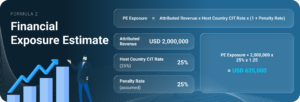
This formula provides an indicative estimate of potential financial exposure from a PE, combining attributed revenue, the host country’s corporate tax rate, and potential penalties. It helps employers understand the financial impact of PE risk and prioritize cases for further review.
-
Formula 3: Days Threshold Tracking
| Days in Country = Sum of all calendar days spent physically present in the jurisdiction during the assessment period
Count every day physically in the country, including weekends and public holidays if the employee is present. Most fixed-place PE thresholds in OECD-based treaties are defined in months (often 12 months for construction sites). Agency PE has no day count threshold; it depends on whether contracts are habitually concluded there. Service PE thresholds are typically 183 days in any 12-month period under UN Model treaties. Build a day-count register for every cross-border employee. |

This formula tracks an employee’s total physical presence in a country during the assessment period, including weekends and holidays. Monitoring cumulative days helps employers identify when treaty or service PE thresholds may be approaching and supports timely compliance reviews.
-
Formula 4: Attribution of Profits to PE
| PE Profit = (PE Revenue – Directly Attributable Costs) x Transfer Pricing Adjustment
Once PE is established, the host country taxes the profits attributable to it. The arm’s length principle (OECD Transfer Pricing Guidelines) governs how profits are split between the PE and the rest of the enterprise. The PE is treated as if it were a separate enterprise dealing at arm’s length with the rest of the company. This calculation requires a formal transfer pricing study and can result in significant back-tax assessments if the attribution is disputed. |

PE Risk Assessment Matrix
The matrix below scores common cross-border work scenarios on PE risk and recommends the appropriate employer action. Activity scores reflect the 2017 OECD Model update.
| Scenario | Duration | Activity Score | Risk Level | Recommended Action |
| Attendee: 3-day industry conference | 3 days | 0 (no business) | LOW | No action needed |
| Internal training: 2-week product workshop | 14 days | 1 (education) | LOW | Document as training, no commercial purpose |
| Short-term project manager, 4 months | 4 months | 2 (operational) | LOW-MED | Get tax opinion; no treaty breach likely |
| Sales rep, no signing authority, 6 months | 6 months | 3 (sales support) | MED | Restrict to support role only; monitor days |
| Account exec, closes contracts, 8 months | 8 months | 5 (signs contracts) | HIGH | Consult tax adviser; EOR or entity may apply |
| Country manager, hires staff, 12+ months | 12+ months | 5 (full authority) | VERY HIGH | Immediate tax opinion; register entity |
| Remote worker, self-directed, 18 months | 18 months | 4 (revenue gen.) | HIGH | Likely PE; formal tax analysis required |
This matrix is illustrative only and not a substitute for a country-specific legal and tax opinion. Actual PE determination depends on the specific bilateral tax treaty, the domestic law of the host country, and the full facts of the arrangement.
Why PE Risk Matters for Employers?
PE exposure is one of the most serious unmanaged tax risks in international business. The financial consequences can be severe, and they compound over time if the exposure is not identified and addressed.
Corporate Tax Liability
If a tax authority concludes that a PE existed, it will assess corporate income tax on all profits attributable to that PE for every year it existed, not just the year of discovery. A PE that ran for three years before being identified generates three years of back taxes, plus interest (typically 4% to 8% per year), plus penalties for failure to register and file. In high-rate jurisdictions like Germany or France, the combined back-tax assessment can easily reach seven figures even for a modestly sized commercial operation.
Payroll Tax and Social Security Consequences
A PE triggers not just corporate income tax obligations but also payroll tax registration requirements. Once a PE exists, the employer is required to register as an employer in the host country, withhold income tax from employees’ wages, and make social security contributions. Failure to register and withhold creates a separate stream of penalties for payroll non-compliance, independent of the corporate income tax assessment. For a company that employed 10 people through an unregistered PE for three years, the back payroll taxes, employer social security contributions, and penalties can be as significant as the corporate tax liability itself.
Reputational and Banking Risk
A PE assessment by a foreign tax authority is a matter of public record in many jurisdictions. For publicly listed companies, it may require disclosure in financial statements under IFRS or US GAAP as a contingent liability. Banks and institutional investors increasingly screen for undisclosed tax liabilities. A large PE assessment that emerges without prior disclosure can affect credit ratings, lending terms, and share price. For smaller companies, the more immediate risk is that a surprise tax liability disrupts cash flow at a critical growth stage.
PE Risk in Switzerland and Across Countries
PE rules vary in their thresholds, definitions, and enforcement intensity across countries. Switzerland is both a common source of outbound PE risk (Swiss companies sending people abroad) and a destination where foreign companies can inadvertently create a PE.
Switzerland as a PE Host Country
Switzerland’s domestic PE definition is contained in the Federal Law on Direct Federal Tax (DBG) and in the bilateral tax treaties Switzerland has with over 100 countries. Switzerland generally follows the OECD Model for treaty PE definitions. The Swiss Federal Tax Administration (FTA) and cantonal tax authorities have become more active in identifying foreign companies operating through employees in Switzerland without registration.
The Swiss corporate income tax rate varies significantly by canton. The effective combined federal, cantonal, and municipal rate ranges from approximately 11.9% in Zug to approximately 21.6% in Geneva (2024 figures). For a foreign company with a Swiss PE, the tax assessment will apply the rate of the canton where the PE is located. Low-tax cantons like Zug and Lucerne are attractive as formal entity locations but do not reduce PE exposure in other cantons where employees actually work.
Switzerland applies a 12-month construction site threshold for fixed-place PEs under most of its treaties. The dependent agent PE threshold follows the 2017 OECD update in treaties signed or renegotiated after 2017, though older treaties may still use the pre-2017 language. Employers must identify which treaty version applies to each specific corridor.
| Country | Fixed-Place PE Threshold | Agency PE Trigger | Construction Site PE | CIT Rate (2024) | Enforcement Intensity |
| Switzerland | No fixed threshold; fixed place with permanence | Habitual authority to conclude contracts (2017 OECD) | 12 months (most treaties) | 11.9% to 21.6% (canton-dependent) | High; FTA increasingly proactive |
| Germany | No fixed threshold; regularity and permanence | Habitual authority; 2017 OECD update in newer treaties | 12 months (OECD model) | Approx. 30% combined | Very high; Finanzamt aggressive on remote workers |
| France | No fixed threshold; place with permanence | Habitual authority; contract conclusion | 12 months | 25% | High; Service PE provisions in some treaties |
| United States | No fixed threshold; regular and continuous use | Dependent agent with authority to conclude contracts | 12 months (most treaties) | 21% federal + state | High; IRS scrutiny on international arrangements |
| United Kingdom | No fixed threshold; place with permanence | Dependent agent with contracting authority | 12 months | 25% (from April 2023) | High; HMRC has dedicated transfer pricing unit |
| Netherlands | No fixed threshold; permanent place of business | Habitual authority to bind the company | 12 months | 25.8% (above EUR 200,000) | Moderate to high; advance tax rulings available |
| Singapore | No fixed threshold; place with permanence | Dependent agent rules apply | 6 months (most treaties) | 17% | Moderate; IRAS practical approach on short assignments |
| UAE | No corporate income tax (federal); DIFC has own rules | N/A for most purposes | N/A | 9% (from June 2023, above AED 375,000) | Low; primary concern is licensing, not CIT PE |
PE Risk vs. Corporate Tax Residency
Both PE risk and corporate tax residency determine where a company pays corporate income tax. They are related but distinct concepts with different triggers and consequences.
| Dimension | Permanent Establishment (PE) | Corporate Tax Residency |
| Definition | A taxable business presence created in a foreign country | The country where the company is treated as a resident taxpayer |
| How it arises | Through physical presence, employees, agents, or construction activities in a foreign country | Through incorporation, place of management, or place of effective management |
| What gets taxed | Only the profits attributable to the PE in that country | All worldwide profits (subject to double tax treaties) |
| Can exist without entity? | Yes: PE is taxable presence without a legal entity | No: residency requires legal connection to the jurisdiction |
| Treaty protection | Treaties limit PE definitions and set thresholds | Treaties determine which country has primary taxing right |
| Triggered by employees? | Yes: employees working in a country are the most common PE trigger | No: employees working abroad don’t typically change the company’s residency |
| Payroll consequence | PE triggers payroll registration requirement in host country | Residency change triggers full tax registration, not just payroll |
| How to avoid | Restrict employee activities; use EOR; monitor day counts | Maintain board meetings and management decisions in home country |
| Resolution | Register the PE and file; or restructure to remove it | Formal change of registered jurisdiction (complex, costly) |
| Switzerland relevance | Swiss companies sending employees abroad face PE risk; foreign companies with Swiss remote workers face PE risk in Switzerland | Swiss company losing Swiss residency if management moves abroad; rare but serious |
Best Practices for Managing PE Risk
Screen Every Cross-Border Work Arrangement Before Approval
Build a pre-approval workflow for any employee who will work in a foreign country for more than 30 days. The screen should capture: the country, the intended duration, the nature of the work (operational support vs. sales vs. contract execution), and whether the employee will have authority to bind the company contractually. Route arrangements that score medium or above on the PE risk matrix to a tax adviser before the work begins, not after.
Track Physical Presence Days in Real Time
Most PE thresholds, social security exemptions, and individual income tax treaty protections depend on day counts. A spreadsheet updated manually by HR once a quarter is not sufficient. Implement a travel tracking system that logs every trip, including the entry and exit date, country, and business purpose. Run automated alerts when an employee’s cumulative days in any country approach 80% of the applicable threshold. This gives the company time to restructure the arrangement before the threshold is breached, rather than after.
Define Employee Activities Explicitly and in Writing
The difference between an agency PE and no PE often turns on whether the employee habitually concludes contracts. Define the scope of each cross-border role in writing, specifying what the employee can and cannot do: they can introduce customers, present proposals, and discuss terms, but all contracts must be reviewed and executed by a person in the home country. Document this restriction in the employment contract or assignment letter and ensure the employee understands and follows it. If an employee deviates from the restriction and starts signing contracts abroad, the employer is exposed regardless of what the policy says.
Use an Employer of Record for Ongoing Roles
When a business need requires an employee to work in a foreign country for more than six months in a revenue-generating or operational role, the cleanest solution is often to engage that person through an Employer of Record in the host country. The EOR is a registered employer in the jurisdiction and the employee appears on the local payroll. This resolves the payroll tax and social security compliance issues immediately. It does not automatically eliminate PE risk for corporate income tax purposes if the employee’s activities would have created a PE anyway, but it addresses the payroll dimension and demonstrates good faith to the tax authority.
Obtain a Written Tax Opinion Before High-Risk Assignments
For any cross-border arrangement that scores high on the PE risk matrix, obtain a written opinion from a qualified tax adviser in the host country before the work starts. The opinion should address: whether the planned activities constitute a PE under the applicable treaty and domestic law; what steps the employer should take to reduce or eliminate the risk; and if a PE exists, how to register and comply. A written opinion also provides the company’s tax team and auditors with documented evidence that the PE position was considered and a defensible conclusion reached, which is relevant for financial statement disclosure and in any future audit.
How Applic8 Handles PE Risk?
Applic8 does not provide legal tax opinions on PE, which require analysis by qualified local tax counsel. What As1 does is give HR and finance teams the data they need to identify PE risk before it becomes a liability.
As1 tracks the country of work and cumulative days in each jurisdiction for every employee in the system. When an employee’s recorded presence in a country approaches a configurable threshold, the platform generates a compliance alert to the HR or mobility manager. This early warning system is designed to give employers time to restructure arrangements, reduce days, or obtain a tax opinion before the threshold is crossed.
For Swiss employers, As1 flags employees working cross-border who may be creating Quellensteuer obligations in Switzerland or payroll tax obligations abroad. The platform records the activity type for each cross-border assignment, allowing the mobility team to run PE risk reports sorted by risk score, country, and duration without manual data collection from multiple systems.
When an employer decides to register a PE or establish a local entity in a host country, As1 supports the transition from an unregistered arrangement to a compliant local payroll, including BVG enrollment, AHV registration, and Quellensteuer setup for inbound Swiss situations, or equivalent setups in other markets.
Concerned about PE risk in your cross-border workforce?
Book a demo with the Applic8 team to see how As1 tracks international employee presence and flags compliance thresholds before they are breached
Frequently Asked Questions About Permanent Establishment Risk
What triggers a permanent establishment?
A PE is triggered in three main ways. A fixed-place PE arises when a company has a specific location in a foreign country, including a home office, used regularly for business. An agency PE arises when an employee habitually concludes contracts on the company’s behalf in the foreign country, even without a fixed office. A construction site PE arises when a project lasts longer than the threshold in the applicable tax treaty, typically 12 months under OECD-based treaties. Remote employees working from home in a foreign country are an increasingly common trigger for both fixed-place and agency PE, depending on their role and the nature of their activities.
What is the difference between a PE and a subsidiary?
A subsidiary is a legally registered entity in the foreign country, with its own corporate registration, bank accounts, financial statements, and tax filings. It is a formal, deliberate structure. A PE is an unintentional or informal taxable presence created by the company’s activities, without a separate legal entity. A subsidiary provides a clean legal and tax structure with predictable obligations. A PE creates obligations and exposure without the legal clarity of an entity. Companies that discover they have a PE often choose to formalize it by establishing a subsidiary or branch, which replaces the unregistered PE with a compliant registered structure.
Does remote work create permanent establishment risk in Switzerland?
Yes. A foreign company whose employee works from home in Switzerland regularly and for an extended period may have a fixed-place PE there, particularly if the employee is conducting core business functions rather than purely preparatory or support activities. Switzerland’s Federal Tax Administration has increased scrutiny of remote work arrangements since 2021. The risk is highest when the employee has revenue-generating responsibilities, authority to represent the company commercially, or a long-term arrangement without a defined end date. As1 tracks cross-border employee presence and activity types, alerting HR teams when arrangements approach risk thresholds. A formal tax opinion from a Swiss tax adviser is recommended for any arrangement lasting more than three months.
How can an employer reduce PE risk without ending the assignment?
Four measures reduce PE risk without stopping the work. First, restrict the employee’s authority: document clearly that the employee cannot sign contracts or make binding commitments on the company’s behalf; all commercial decisions must be approved in the home country. Second, limit the duration: keep assignments under the applicable treaty threshold; rotate employees if the business need is ongoing. Third, use an Employer of Record: putting the employee on a local EOR payroll resolves the payroll tax compliance issue, though it does not automatically eliminate the corporate income tax PE if the employee’s activities would otherwise create one. Fourth, register proactively: if PE is unavoidable, registering a branch or entity before the tax authority identifies the exposure is far less costly than a retrospective assessment with penalties.
What happens if a PE is discovered by a tax authority?
The tax authority will assess corporate income tax on the profits attributable to the PE for every year the PE existed, plus interest on the unpaid tax (typically 4% to 8% per year) and penalties for failure to register and file (10% to 50% of the tax owed in many jurisdictions). Separately, the authority may assess payroll taxes and employer social security contributions for the same period. In some countries, individual officers of the company can face personal liability for unpaid payroll taxes. The total exposure from a multi-year unregistered PE can be several times larger than the annual tax bill would have been if the PE had been registered from the start. Early disclosure, where the employer comes forward voluntarily before the authority identifies the PE, typically reduces penalties significantly

