


What Is Tax Equalization?
In brief: Tax equalization is an employer policy that ensures an internationally assigned employee pays no more and no less in taxes than they would have paid if they had remained in their home country. The employer deducts a hypothetical tax from the employee’s compensation, pays all actual taxes in the host country, and then settles the difference. The assignee’s net pay stays the same wherever they work.
How does Tax Equalization Work?
Tax equalization is built on a three-step process that runs throughout the assignment and is settled after the employee’s annual tax returns are filed in both the home and host countries.
Step 1: Hypothetical Tax
At the start of the assignment, the employer calculates the hypothetical tax: the estimated income tax the employee would have paid in their home country if they had never moved. This calculation uses the employee’s home country salary, filing status, standard deductions, and applicable rates. The hypothetical tax is deducted from the employee’s gross pay each payroll period, just like a normal withholding. The employee’s net paycheck reflects home-country tax levels, not host-country levels.
The hypothetical tax typically covers the employee’s home country income tax and the employee portion of social security and Medicare (for US assignees). It does not usually include taxes on investment income, real estate, or other non-employment items, which remain the employee’s personal responsibility.
Step 2: Employer Pays Actual Taxes
The employer pays all actual income taxes owed in the host country and any remaining home country taxes on assignment income. This is paid directly to the tax authorities or through the payroll. The employer also pays the assignee’s portion of host country social security contributions where required. The employee does not write a personal check to a foreign tax authority. The employer handles it all.
For US citizens, this is particularly complex because the United States taxes citizens on worldwide income regardless of where they live. A US assignee in Switzerland owes US taxes as well as Swiss taxes. The employer must coordinate both. The Foreign Earned Income Exclusion (FEIE) and Foreign Tax Credits reduce the double-tax burden, but FICA (Social Security and Medicare) taxes continue to apply to the employer regardless of where the employee works, unless a Social Security totalization agreement applies.
Step 3: Annual Settlement
After the tax year closes, the employer files the actual tax returns in every relevant jurisdiction. Once the actual tax liability is confirmed, the employer compares it to the hypothetical tax collected from the employee throughout the year. If the employer paid more than the hypothetical tax retained, the employer absorbs the difference. If actual taxes were lower than the hypothetical tax retained, the employer keeps the excess.
This settlement can take 12 to 24 months to complete because it depends on when tax returns are filed and assessed in each country. The employer carries an open liability on the balance sheet until the settlement is final.
The Tax Gross-Up Problem
When the employer pays the employee’s taxes, those tax payments are themselves considered additional taxable compensation in most jurisdictions. This creates a second layer of tax on the tax payment, known as the gross-up. If the employer pays USD 30,000 in Swiss taxes on behalf of the employee, the Swiss tax authority may treat that USD 30,000 as additional income and tax it at the marginal rate. The employer must then pay tax on that tax payment too. In high-tax jurisdictions, this gross-up chain can add 15% to 30% to the cost of the tax equalization program.
Ready to tracks tax deductions and country tax payments ?
Applic8 tracks hypothetical tax deductions and host country tax payments through As1, giving mobility and payroll teams a real-time view of the tax equalization liability on every assignment.
Tax Equalization Formulas
These formulas are the foundation of any tax equalization program. They can be applied to any assignment corridor once the home and host country tax rates are known.
Core Formulas
-
Formula 1: Hypothetical Tax
| Hypothetical Tax = f(Home Country Tax Rates, Home Country Salary, Filing Status, Deductions)
The formula Hypothetical Tax = f(Home Country Tax Rates, Home Country Salary, …) uses f to represent a “function” think of it as the automatic calculator or rulebook that processes your Home Country Salary, Filing Status, and Deductions through official Home Country Tax Rates to generate your final tax amount. This is not a simple percentage. It requires running the employee’s home country salary through the home country’s actual tax tables, applying the correct filing status, standard deductions, and any applicable credits. For US assignees: apply 2024 federal brackets (10%, 12%, 22%, 24%, 32%, 35%, 37%), state income tax rate, plus Social Security (6.2% up to $168,600) and Medicare (1.45%). Update every year as rates and brackets change. |

-
Formula 2: Hypothetical Tax Retained Per Pay Period
| Per-Period Hypo Tax = Annual Hypothetical Tax / Number of Pay Periods in Year
For monthly payroll: Annual Hypo Tax / 12. For bi-weekly payroll: Annual Hypo Tax / 26. This amount is deducted from the employee’s gross compensation each pay period in place of the actual host country withholding. Example: annual hypo tax USD 79,953 / 12 = USD 6,663 per month retained. |
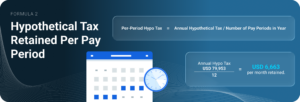
Hypothetical Tax Retained Per Pay Period is the amount deducted from the employee’s salary each pay period for hypothetical tax. The annual hypothetical tax is simply divided by the number of pay periods in the year.
-
Formula 3: Employer Tax Equalization Cost
| Employer TEQ Cost = Total Actual Taxes Paid by Employer – Total Hypothetical Tax Retained from Employee
If positive: employer absorbs the difference (host country taxes exceed home country equivalent). If negative: employer retains the excess (home country taxes exceed host country actual). Example: actual taxes USD 80,785 minus hypo tax USD 79,953 = employer cost of USD 832 in this case. For a France assignment, actual taxes might be USD 130,000 versus USD 79,953 hypo = employer absorbs USD 50,047. |
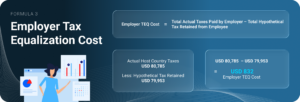
Employer Tax Equalization Cost is the difference between the actual tax paid by the employer and the hypothetical tax deducted from the employee. The employer covers any amount where the actual tax is higher.
-
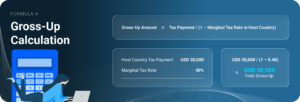
Formula 4: Gross-Up Calculation
| Gross-Up Amount = Tax Payment / (1 – Marginal Tax Rate in Host Country)
When the employer pays taxes on behalf of the employee, those payments are additional income. The gross-up converts a net tax payment into the gross amount needed so that after tax on the payment itself, the net tax obligation is covered. Example: employer pays USD 30,000 in host country taxes. Marginal rate 40%. Gross-up = USD 30,000 / (1 – 0.40) = USD 50,000. Employer must pay USD 50,000 so that USD 20,000 goes to tax on the payment and USD 30,000 covers the original obligation. |
-
Formula 5: Total Assignment Tax Cost
| Total Tax Cost = Actual Host Taxes + Residual Home Country Taxes + Gross-Up Amount – Hypo Tax Retained
This is the full tax cost the employer bears per assignment year. It feeds directly into the total assignment cost budget. For US-to-high-tax-country assignments, total tax cost routinely equals or exceeds the employee’s base salary in the first year. |
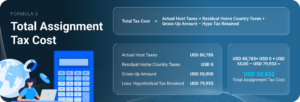
Total Tax Cost is the employer’s overall tax expense for the assignment. It includes host-country taxes, any remaining home-country taxes, and gross-up, minus the hypothetical tax retained from the employee.
Worked Example: US Employee Assigned to Switzerland
The following table walks through a full tax equalization calculation for a US employee earning USD 200,000 assigned to Switzerland for two years. Rates are based on 2024 figures.
| Tax Equalization: US Employee Assigned to Switzerland | Amount (USD) | Notes |
| STEP 1: HYPOTHETICAL TAX (what employee would have paid at home in the US) | ||
| Annual base salary | 200,000 | |
| US federal income tax (MFJ 2024 effective rate ~24%) | 48,000 | Married filing jointly, standard deduction applied |
| Social Security tax (6.2% on wages up to $168,600) | 10,453 | 2024 wage base cap |
| Medicare tax (1.45%) | 2,900 | No earnings ceiling |
| State income tax (e.g., California est. 9.3%) | 18,600 | Assumed home state |
| TOTAL HYPOTHETICAL TAX RETAINED FROM EMPLOYEE | 79,953 | Deducted from employee gross each pay period |
| STEP 2: ACTUAL HOST COUNTRY TAX (Switzerland) | ||
| Swiss federal income tax (est. effective rate 11.5%) | 23,000 | Federal level; varies by marital status |
| Swiss cantonal + municipal tax (Canton Zurich est. 16%) | 32,000 | Highest combined rate in Zurich for this income |
| AHV/IV/EO employee contribution (5.30%) | 10,600 | No earnings ceiling |
| ALV unemployment insurance (1.10% up to CHF 148,200) | 1,832 | Annual cap applies; USD equivalent approx. |
| US taxes still owed (FICA + net US federal after FEIE) | 13,353 | Foreign Earned Income Exclusion reduces US federal tax; FICA still applies |
| TOTAL ACTUAL TAX BURDEN | 80,785 | Paid by employer on behalf of employee |
| STEP 3: TAX EQUALIZATION SETTLEMENT | ||
| Actual tax paid by employer | 80,785 | |
| Hypothetical tax retained from employee | 79,953 | |
| Employer tax equalization cost (net) | 832 | 80,785 minus 79,953. Employer owes near-nothing in this example. |
| NOTE: If host tax were higher (e.g., France at ~55% effective) | Employer cost would be USD 30,000 to USD 50,000+ per year | |
Key takeaway: Switzerland has a relatively moderate tax burden compared to countries like France or Belgium, so the equalization cost in this example is minimal. The same employee assigned to France (effective combined rate exceeding 55%) would generate an employer equalization cost of USD 30,000 to USD 50,000 per year or more.
Why Does Tax Equalization Matter for Employers?
Tax equalization is both a talent tool and a significant financial obligation. Companies that run assignments without it face the two problems it solves: employees who refuse high-tax assignments, and employees who game the system by seeking low-tax postings.
Removing Tax as a Barrier to Mobility
Without tax equalization, an employee assigned to France or Germany faces a dramatically higher personal tax bill than they would at home. Most employees will refuse the assignment unless compensated for the tax hit, which means negotiating individual allowances that are inconsistent across the program. Tax equalization removes the tax variable entirely. The employee focuses on the role, not the tax rate in the destination country.
Preventing Unintended Windfall or Loss
Without equalization, an employee sent to a low-tax jurisdiction like the UAE or Singapore receives a personal tax windfall. Without policy, there is no mechanism to recapture this. Over time, employees seek low-tax postings for personal financial benefit rather than business need, distorting the mobility program. Equalization eliminates both the windfall and the loss: the employer captures excess in low-tax countries and covers shortfalls in high-tax ones.
Balance Sheet Exposure
Tax equalization creates a contingent liability for the employer that remains open until every relevant tax return is filed and assessed. For a large mobility program with 100 assignees across 20 countries, the aggregate outstanding tax liability can be material. Finance teams must accrue this liability using estimated settlement amounts and update the accrual as actual returns are filed. Delays in filing increase the period of uncertainty and the balance sheet exposure.
Tax Equalization in Switzerland and Across Countries
Tax equalization complexity varies by assignment corridor. The home country’s tax regime and the host country’s tax burden together determine the cost and administrative effort involved.
Switzerland as a Host Country
Switzerland is considered a moderate-to-low tax host country relative to other Western European nations. Combined federal, cantonal, and municipal income tax rates for a single earner at USD 200,000 equivalent range from approximately 20% in low-tax cantons (Zug, Schwyz, Nidwalden) to approximately 35% in higher-rate cantons (Geneva, Vaud, Bern). For US assignees, this means Switzerland is often a low-cost or neutral equalization destination compared to the hypothetical US tax rate on the same income.
However, Switzerland’s complexity arises from two sources. First, Quellensteuer: foreign national employees without a C permit are subject to Swiss withholding tax at cantonal tariff rates. The employer must apply the correct tariff based on canton of work, civil status, number of dependents, and gross income level. Second, US citizenship: US assignees owe both Swiss and US taxes. The US-Switzerland tax treaty reduces double taxation, and the Foreign Tax Credit allows the employee to credit Swiss taxes paid against US liability. But FICA contributions (Social Security and Medicare) continue regardless of the treaty, and the US-Switzerland Totalization Agreement determines which country’s social security system applies.
| Assignment Corridor | Home Country Hypo Tax (Effective Rate) | Host Country Effective Rate | Typical Employer TEQ Cost Direction | Key Complexity |
| US to Switzerland | Federal + State ~33% effective | Combined ~25-35% (canton-dependent) | Near-neutral to employer benefit | FICA still applies; Quellensteuer admin; FEIE coordination |
| US to France | Federal + State ~33% effective | Combined ~48-55% | Employer cost: USD 30,000 to USD 60,000+ per year | Complex French social charges; gross-up burden significant |
| US to Germany | Federal + State ~33% effective | Combined ~42-48% | Employer cost: USD 15,000 to USD 40,000 per year | Church tax; 4 social insurance branches; Lohnsteuer |
| US to UAE | Federal + State ~33% effective | 0% income tax | Employer retains excess: up to USD 50,000 per year | FICA still owed; employee retains nothing of UAE tax advantage |
| Swiss to Germany | Swiss combined ~25-35% | German combined ~42-48% | Employer cost depending on canton vs. German state | BVG portability; AHV coordination; Grenzgaenger rules |
| Swiss to UK | Swiss combined ~25-35% | UK combined ~40-48% on high earners | Employer cost in most cases | UK National Insurance; post-Brexit social security gap |
| UK to Switzerland | UK combined ~42-45% | Swiss combined ~25-35% | Employer retains excess (low-cost assignment for employer) | Swiss permit required; BVG enrollment from day one |
The US Citizen Complexity
The United States is one of only two countries (with Eritrea) that taxes citizens on worldwide income regardless of residence. A US citizen assigned anywhere in the world still owes US income taxes on their global compensation after applying the Foreign Earned Income Exclusion ($126,500 for 2024) and Foreign Tax Credits. FICA taxes apply to all wages paid by US employers regardless of the employee’s location, unless a Social Security totalization agreement exempts the employee from US FICA. Switzerland and the United States have a totalization agreement: an employee posted to Switzerland for a defined period can apply to remain in the US Social Security system and be exempt from Swiss AHV, or vice versa.
Tax Equalization vs. Tax Protection
Both policies shield the employee from adverse tax outcomes on international assignments, but they operate differently and have very different cost implications for the employer.
| Dimension | Tax Equalization | Tax Protection |
| Core principle | Employee pays exactly home country tax, no more no less | Employee pays no more than home country tax; may pay less |
| Low-tax host country | Employer retains the tax windfall | Employee keeps the tax windfall |
| High-tax host country | Employer covers the excess over hypo tax | Employer covers the excess over hypo tax |
| Employee outcome | Tax-neutral in all locations | Tax-neutral in high-tax; tax-advantaged in low-tax |
| Employer cost | Predictable: employer retains low-tax savings | Unpredictable: employer covers high-tax but shares no benefit |
| Incentive effect | Neutral: employee indifferent to assignment location | Distorting: employees prefer low-tax locations |
| Policy consistency | Uniform across all assignments | Uniform across high-tax only; variable in low-tax |
| Administrative burden | Full: annual settlement in all cases | Full: annual settlement in high-tax cases |
| Most common for | Standard corporate mobility programs | Legacy programs; specialized roles |
| Recommended? | Yes, for programs with assignments across multiple tax environments | Only if equalization is not feasible; creates windfall risk |
Tax equalization is the dominant standard in multinational mobility programs because it is policy-consistent and cost-predictable. Tax protection creates an asymmetric outcome that benefits employees in low-tax locations at the employer’s expense without any corresponding cost reduction for the employer. Most large programs migrated from tax protection to tax equalization in the 1980s and 1990s. New programs should default to equalization.
Best Practices for Tax Equalization
Calculate and Communicate the Hypothetical Tax Before the Assignment Starts
The hypothetical tax determines the employee’s net pay for the entire assignment. Calculate it accurately before the offer letter is signed and share it with the employee in writing. Errors in the initial hypo tax calculation cascade through every payroll run and require correction when the annual settlement is done. If the hypo tax is set too low, the employee receives more net pay than intended and may have to pay back funds at year-end settlement. If set too high, the employee is short-changed every month.
Update the Hypothetical Tax Every Year
Home country tax rates, brackets, and the employee’s filing status can change from year to year. Recalculate the hypothetical tax at the start of each assignment year, adjust the per-period deduction from the first payroll of the new year, and notify the employee of any change. Do not carry a stale hypo tax calculation through multiple years without review.
File Tax Returns in Every Jurisdiction Without Delay
The tax equalization settlement cannot be finalized until actual tax returns are filed and assessed in both home and host countries. Every month a return is delayed is a month the employer carries an unresolved open liability on the balance sheet and the employee has uncertainty about their final tax position. Retain local tax advisers in both jurisdictions before the assignment starts and build return filing deadlines into the assignment calendar.
Budget for Gross-Up Costs Explicitly
Gross-up costs are frequently omitted from assignment cost estimates because they are indirect. For any assignment to a country where the employer’s tax payment is treated as additional income, calculate the gross-up using Formula 4 and include it in the total assignment budget. On high-tax assignments, the gross-up can increase the total tax cost by 20% to 40% above the headline tax liability. A finance team that sees only the top-line tax number will underestimate the true cost significantly.
Use a Split-Payroll Structure for Dual-Tax Countries
US citizens on assignment are subject to both US and host country taxes. Running a split payroll, where one portion of the salary is paid from the US payroll and one from the host country payroll, allows each portion to be withheld and reported correctly in its jurisdiction. This simplifies the annual tax return preparation and reduces the risk of under-withholding in either country. For Swiss assignments, the host country payroll must also handle Quellensteuer withholding, BVG pension contributions, and AHV registration, making accurate system configuration before the first payroll run essential.
How Does Applic8 Handle Tax Equalization?
Applic8 supports tax equalization administration for assignments involving Switzerland through the As1 payroll platform. As1 stores the hypothetical tax figure for each assignee and deducts it automatically each pay period in place of standard withholding. When the assignment year ends, the platform generates a reconciliation report comparing the cumulative hypothetical tax retained against the actual tax payments recorded, giving the mobility team the data needed to complete the annual settlement without manual reconstruction from multiple systems.
For inbound assignees to Switzerland, As1 applies the correct Quellensteuer tariff based on the employee’s canton of work, civil status, number of dependents, and gross monthly income. When the gross income in the payment month is higher because of the tax equalization true-up payment itself, the platform flags the adjusted tariff rate to prevent under-withholding. AHV/IV/EO, ALV, and BVG contributions are calculated on the full assignment compensation package including allowances, not just the base salary.
For US assignees, As1 coordinates the Swiss and US payroll calculations, tracking year-to-date compensation against the FEIE limit and FICA wage base, so withholding in each country is correct from the first payroll run of the assignment. Mobility and finance teams access real-time assignment tax cost reports that roll up across all active assignments, supporting balance sheet accruals and year-end disclosure.
Managing assignees in and out of Switzerland?
Book a demo with the Applic8 team to see how As1 tracks hypothetical tax deductions, Quellensteuer, and TEQ settlements in one platform
Frequently Asked Questions About Tax Equalization
How is tax equalization calculated?
Tax equalization is calculated in three steps. First, compute the hypothetical tax: run the employee’s home country salary through the home country’s tax tables to determine what they would have paid at home. For US employees, this uses federal and state income tax brackets, Social Security (6.2% up to $168,600 in 2024), and Medicare (1.45%). Second, deduct the hypothetical tax from the employee’s gross pay each payroll period. Third, the employer pays all actual taxes owed in the host country and any remaining home country taxes. At year-end, the employer compares actual taxes paid to hypothetical tax collected and settles the difference. If actual taxes exceed hypo tax, the employer absorbs the cost. If actual taxes are lower, the employer retains the surplus.
What is the difference between tax equalization and tax protection?
Tax equalization makes the employee tax-neutral in all locations: they pay exactly what they would have paid at home, no more and no less. If the host country tax is lower than home, the employer retains the saving. If higher, the employer covers the excess. Tax protection only shields the employee from tax increases: if the host country tax is higher than home, the employer covers the excess, but if host country tax is lower, the employee keeps the windfall personally. Tax protection costs more over time because the employer absorbs all downside but shares none of the upside. Tax equalization is the standard for most corporate mobility programs because it is cost-predictable and policy-consistent.
Does tax equalization apply in Switzerland?
Yes. Tax equalization is commonly applied to assignments into and out of Switzerland. For inbound assignees, Switzerland’s combined federal, cantonal, and municipal income tax rates range from approximately 20% in low-tax cantons to approximately 35% in higher-rate cantons, making it a moderate-cost equalization destination. For US assignees specifically, Switzerland is often near-neutral because US effective rates on similar incomes are comparable to Swiss rates. The employer still has to manage Quellensteuer withholding for foreign national employees, AHV/IV/EO contributions, and US-Switzerland totalization agreement applications. As1 handles all of these within the same payroll run, reducing the administrative burden on the mobility team.
What is a hypothetical tax and how is it used?
A hypothetical tax is the estimated income tax the employee would have paid in their home country if they had never gone on assignment. It is calculated at the start of each assignment year using home country tax tables, the employee’s filing status, and their compensation level. This amount is withheld from the employee’s gross pay each payroll period, just like a normal tax deduction. It represents the employee’s share of taxes. The employer then pays all actual taxes in the host country. At year-end, actual taxes are compared to the hypothetical tax collected to determine the final settlement amount. The hypothetical tax must be recalculated every year when tax rates or the employee’s circumstances change.
What is a tax gross-up and when does it apply?
A tax gross-up applies when the employer pays taxes on behalf of the employee and those payments are treated as additional taxable income in the host country. Because the employer’s tax payment creates new income, there is a second layer of tax on top of the first. The gross-up converts a net tax obligation into the gross amount needed to cover both the original tax and the tax on the tax payment. The formula is: Gross-Up = Tax Amount / (1 – Marginal Host Country Rate). Example: employer pays USD 30,000 in host taxes. Marginal rate 40%. Gross-up = USD 30,000 / 0.60 = USD 50,000. Gross-ups are mandatory in most jurisdictions where employer tax payments are treated as compensation and must be included in total assignment cost budgets.

