What Is Payroll Consolidation?


Payroll consolidation is the process of bringing multiple separate payroll systems, providers, or processes into a single unified platform or operating model. It gives finance and HR teams one source of payroll data across all countries and entities, reduces duplication, lowers compliance risk, and makes global workforce costs easier to control and report.


How Payroll Consolidation Works?


Payroll consolidation moves an organization from running separate, disconnected payroll operations in each country to a single model where data, processes, and reporting flow through one platform or one coordinated provider network. The goal is not to eliminate local compliance requirements, which remain country-specific, but to centralize control, data visibility, and operational oversight.

A consolidated payroll model typically operates at one of three levels: technology consolidation (one platform processes all payrolls), provider consolidation (one partner manages all in-country payrolls), or full consolidation (one platform and one provider covering all countries). Most organizations pursue a combination, with a global platform connected to local payroll engines that apply country-specific rules.


The Three Consolidation Models


Technology-led consolidation replaces multiple local payroll systems with one global platform. Local compliance rules, tax tables, and social contribution rates are maintained within the platform for each country. Data flows from a single HR source of truth into the payroll engine, and outputs are standardized across all entities.

Provider-led consolidation keeps existing technology but moves all countries to a single global payroll partner that subcontracts or manages in-country specialists. The client receives one contract, one invoice, and one point of contact. Compliance execution remains local but governance and reporting are unified.

Full consolidation combines a single platform with a single provider network. This is the highest level of integration and the most complex to implement but delivers the greatest visibility and control.


What Changes and What Stays Local?


Consolidation centralizes governance, data, reporting, and process controls. It does not change local employment law obligations. Each country’s payroll still applies its own tax rates, social insurance contribution rules, statutory pay requirements, and pay slip standards. What changes is where the data lives, who oversees the process, and how results are aggregated and reported upwards.

In practice this means a global HR or finance team can see payroll costs across all entities in one dashboard, run global headcount and cost reports without contacting each local team, identify anomalies in any country instantly, and close the books faster because period-end payroll data is available centrally.


Data Integration and the Single Source of Truth


The foundation of any consolidation project is connecting the HR system and the payroll engine so that employee master data flows automatically without manual re-entry. Changes to salaries, contracts, start dates, bank details, and tax codes made in the HR system propagate to payroll in real time. This eliminates the dual-keying errors that cause the majority of payroll corrections in fragmented environments and creates a single source of truth that both HR and finance can rely on.


Ready to consolidates payroll?

Applic8 consolidates payroll across Switzerland and 100+ countries on the As1 platform, giving HR and finance one source of data, one reporting layer, and one compliance framework.

Explore


Payroll Consolidation Formulas and Savings Model


These formulas help finance and HR teams quantify the cost of fragmented payroll, build a business case for consolidation, and measure the return after implementation.


Business Case Formulas


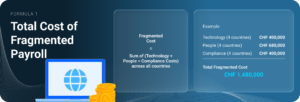
  • Formula 1: Total Cost of Fragmented Payroll

Fragmented Cost = Sum of (Technology + People + Compliance Costs) across all countries

Technology: payroll system licenses, integrations, and IT support per country. People: payroll staff FTEs, external consultants, and management overhead per country. Compliance: audit, tax advisory, penalty, and error correction costs per country. Add all three across every entity to establish the baseline cost before consolidation.

The Total Cost of Fragmented Payroll is the total cost of managing payroll separately in each country. It includes technology costs (systems and IT support), people costs (payroll staff and consultants), and compliance costs (tax, audits, and fixing errors). Adding these costs across all countries shows the current payroll cost before consolidation.


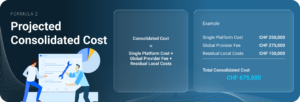
  • Formula 2: Projected Consolidated Cost

Consolidated Cost = Single Platform Cost + Global Provider Fee + Residual Local Costs

Single platform cost: one global system license covering all countries. Global provider fee: a per-employee or percentage-of-payroll fee for consolidated administration. Residual local costs: statutory filing fees, local audit requirements, and any in-country specialists that cannot be fully centralized.

The Projected Consolidated Cost is the expected cost of running payroll through one centralized global solution. It includes the single platform cost (one payroll system for all countries), global provider fees (charges for managing payroll services), and remaining local costs (required local filings, audits, or specialists that cannot be removed). This shows the estimated payroll cost after consolidation.


  • Formula 3: Consolidation Saving

Annual Saving = Fragmented Cost – Consolidated Cost

Fragmented cost across 4 countries = CHF 1,480,000. Consolidated cost = CHF 675,000. Annual saving = CHF 805,000 (54% reduction). One-time implementation cost (migration, training, integration) is typically recouped within 12 to 24 months.

The Consolidation Saving shows how much money a company can save by moving from separate payroll systems to one centralized solution. It is calculated by subtracting the consolidated cost from the fragmented cost. Example: If current payroll costs are CHF 1,480,000 and the new consolidated cost is CHF 675,000, the company saves CHF 805,000 per year (54% reduction). The initial setup costs, such as migration and training, are usually recovered within 12–24 months.

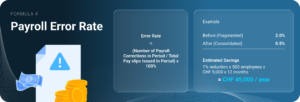
  • Formula 4: Payroll Error Rate

Error Rate = (Number of Payroll Corrections in Period / Total Pay slips Issued in Period) x 100%

Track this metric before and after consolidation. Fragmented payrolls typically show error rates of 1% to 3% of pay slips. Consolidated payrolls with a single data source target below 0.5%. A 1% reduction on 500 employees at CHF 9,000 average monthly salary represents CHF 45,000 in avoided correction costs annually.

The Payroll Error Rate measures how often payroll mistakes occur. It is calculated by dividing the number of payroll corrections by the total number of payslips issued. Tracking this before and after consolidation shows whether a centralized payroll system reduces errors. A lower error rate means fewer corrections, less administrative work, and lower costs. For example, reducing errors by 1% for 500 employees can save around CHF 45,000 per year in correction costs.

  • Formula 5: Time-to-Close (Payroll Contribution to Period-End Close)

Payroll Close Time = Sum of days from payroll cut-off to confirmed payroll data in GL across all entities

Consolidated payrolls reduce this by eliminating manual data collection from multiple systems and providers. Target: consolidated payroll data available in the general ledger within 2 business days of each pay date across all countries, versus 5 to 10 days typical in fragmented environments.

The Time-to-Close metric measures how quickly payroll information is finalized and available in the General Ledger (GL) after payroll processing. A consolidated payroll system reduces delays by removing manual data collection from multiple countries and providers. The goal is to have payroll data available within 2 business days, compared with 5–10 days in fragmented payroll environments.

  • Formula 6: Compliance Risk Exposure Reduction

Risk Reduction Value = Sum of (Penalty Probability x Average Penalty Cost) before minus after consolidation

Before consolidation: 4 countries x 10% annual compliance incident probability x CHF 50,000 average penalty = CHF 20,000 expected annual penalty cost. After consolidation: 4 countries x 3% x CHF 50,000 = CHF 6,000. Risk reduction value = CHF 14,000 per year, which feeds into the ROI calculation alongside direct cost savings.

The Compliance Risk Exposure Reduction measures how much potential penalty cost is reduced after payroll consolidation. It compares the expected compliance costs before and after using a centralized payroll system. By reducing errors and improving compliance controls, companies can lower the risk of fines and penalties. In this example, consolidation reduces expected annual penalty costs from CHF 20,000 to CHF 6,000, creating a CHF 14,000 annual risk reduction benefit.


Consolidation Savings Model


The table below shows a worked example for an organization with 500 employees across 4 countries (Switzerland, Germany, United Kingdom, France). All figures are indicative CHF estimates.

Cost Driver (500 employees, 4 countries) Before Consolidation After Consolidation
TECHNOLOGY
  Payroll systems / licences 4 systems x CHF 80,000 1 system x CHF 120,000
  Integration and data feeds CHF 60,000 CHF 15,000
Technology subtotal CHF 380,000 CHF 135,000
PEOPLE
  Local payroll staff (FTEs) 8 FTE x CHF 90,000 4 FTE x CHF 90,000
  External consultants and advisers CHF 120,000 CHF 40,000
People subtotal CHF 840,000 CHF 400,000
COMPLIANCE
  External audit and tax compliance per country 4 x CHF 45,000 4 x CHF 30,000
  Penalty and error correction cost (est.) CHF 80,000 CHF 20,000
Compliance subtotal CHF 260,000 CHF 140,000
TOTAL ANNUAL COST CHF 1,480,000 CHF 675,000
  Annual saving CHF 805,000 (54%)

Implementation cost (one-time): approximately CHF 200,000 to CHF 400,000 for data migration, system configuration, staff training, and parallel-run testing. At CHF 805,000 annual saving, break-even is typically 3 to 6 months after go-live.


Why Payroll Consolidation Matters?


Finance and HR leaders in multi-country organizations consistently identify fragmented payroll as one of their highest-cost, highest-risk operational problems. Consolidation addresses three interconnected pressures: cost, control, and compliance.


Cost Visibility and Control


When payroll runs across four or more systems, it is genuinely difficult to answer a simple question: what does our global workforce cost this month? Each system holds data in a different format, uses different cost codes, and closes on a different schedule. Finance teams spend days each month aggregating data manually before they can produce a global payroll cost report.

Consolidation puts all payroll data in one place with one taxonomy. Global workforce cost reports are available immediately after each country’s payroll closes, without manual collection. Variance analysis comparing actuals against budget across every entity and cost center becomes a real-time activity rather than a month-end exercise.


Compliance Risk Reduction


Fragmented payroll environments accumulate compliance risk. Each local system must be maintained with current tax rates, social contribution thresholds, and statutory reporting formats. When multiple systems are managed by different teams or providers, rate updates get missed, pay slip formats fall out of compliance, and social insurance declarations contain errors that attract attention during authority audits.

A single consolidated platform with centrally managed regulatory updates removes this risk. When Swiss AHV rates, German social insurance ceilings, or UK National Insurance thresholds change, the update is applied once and flows to every affected payroll automatically.


Audit Readiness and Data Integrity


External auditors and tax authorities request payroll data that can be traced end-to-end from the employment contract to the pay slip to the bank transfer to the social insurance declaration. In fragmented environments, assembling this audit trail across multiple systems and providers takes weeks. In a consolidated environment, the same data is available in minutes from a single platform, reducing audit preparation time and the risk of inconsistencies between different data sources.


Payroll Consolidation in Switzerland and Across Countries


Payroll consolidation in a multi-country context does not mean applying one country’s rules everywhere. It means applying each country’s rules correctly from one platform. The challenge is that every jurisdiction has its own payroll obligations that must be maintained regardless of how centralized the operating model becomes.


Switzerland


Switzerland brings a unique set of challenges to any consolidation project due to its cantonal differences. While the federal social insurance regulations (AHV/IV/EO, ALV, BVG) are uniform across the country, the Quellensteuer tax tables vary among the 26 cantons, and family allowance (FAK) contribution rates differ from one canton to another. For an organization with employees spread across multiple cantons, this means managing 26 different tariff tables and ensuring the right one is applied to each employee based on where they work.

To effectively manage payroll in Switzerland, a consolidated platform needs to seamlessly handle several tasks without any manual input: calculating and remitting monthly AHV/IV/EO and ALV contributions to the cantonal compensation office; determining BVG pension fund contributions based on age bands and sending those to the pension fund; calculating Quellensteuer using the appropriate cantonal rate for each eligible foreign employee; managing FAK family allowance contributions at the correct cantonal rate; overseeing SUVA accident insurance premiums; preparing annual AHV salary declarations for every employee; and generating individual salary certificates in the standard Swiss format.

Additionally, the 2021 update to Swiss Quellensteuer regulations requires employers to identify employees earning over CHF 120,000 annually and inform them about the mandatory supplementary ordinary assessment. A consolidated platform must keep track of year-to-date earnings against this threshold and produce the necessary notifications.


Country Key Payroll Obligations to Consolidate Canton/State Variation Annual Declaration Deadline
Switzerland AHV/IV/EO, ALV, BVG, SUVA, FAK, Quellensteuer Yes: 26 cantons (Quellensteuer tariffs, FAK rates) AHV declaration by 30 January each year
Germany Lohnsteuer, 4 social insurance branches (KV, RV, AV, PV) Minor: east/west ceiling differences Lohnsteuerjahresausgleich by February
France URSSAF, DSN (monthly social declaration), PAS income tax No state variation; complex sectoral conventions DSN submitted monthly; annual recap by January
United Kingdom PAYE, employer NICs, auto-enrolment pension No regional variation Real Time Information: submission each pay day
United States FICA, FUTA, state income tax, state UI Yes: 50 states (income tax, UI rates, employment law) W-2 to employees by 31 January; 940/941 filings
Netherlands Loonbelasting, social premiums, 30% ruling admin No provincial variation Annual wage declaration by January


Payroll Consolidation vs. Payroll Standardization


These two terms are used interchangeably but describe different activities. Both are valuable and they are usually pursued together, but they are not the same thing.

Dimension Payroll Consolidation Payroll Standardization
What it means Bringing multiple systems or providers into one Making processes, policies, and formats consistent
Primary focus Technology, data, and operating model Process design and governance
Output One platform, one data model, one reporting layer Uniform payroll calendars, data formats, approval workflows
Local compliance Unchanged: each country applies its own rules Unchanged: local rules still vary by country
Can exist without the other? Yes: consolidated system, inconsistent processes Yes: consistent processes across multiple systems
Typical sequence Standardize processes first, then consolidate technology Standardization often precedes and enables consolidation
Main risk if skipped Multiple broken processes consolidated onto one platform One clean platform used inconsistently by each country
Measurable outcome Fewer systems, lower cost, faster reporting Lower error rates, faster close, clearer governance

The most successful consolidation projects standardize first. Organizations that move all countries onto a single platform before aligning their processes often find they have replicated the fragmentation of the old model inside the new one. Defining the global payroll calendar, data submission formats, approval chain, and reconciliation methodology before go-live makes the technology consolidation significantly more effective.


Best Practices for Payroll Consolidation


Build the Business Case with Measurable Baselines


Before any technology decisions, document current payroll costs across every country: system licenses, payroll staff, external advisers, compliance costs, and error correction expenses. Use Formula 1 from this glossary to establish the fragmented cost baseline. Without this number, the consolidation investment cannot be justified to finance leadership and the project will compete unsuccessfully with other capital priorities.


Standardize Data and Processes Before Migrating


Agree on a global employee data model, payroll calendar structure, cut-off schedule, and approval workflow before selecting or configuring a platform. Every country must map its local data fields to the global standard before migration begins. Data quality issues found during migration typically account for 40% to 60% of implementation delays in payroll consolidation projects. A data audit and cleansing exercise prior to go-live is not optional.


Run Parallel Payrolls During the Transition Period


For the first one to three months after go-live in each country, run the old and new payrolls simultaneously and compare results. Any discrepancy must be investigated and resolved before the old system is decommissioned. For Swiss payrolls, parallel running is particularly important because AHV, BVG, and Quellensteuer calculations are complex and errors become expensive to unwind once submitted to authorities. Plan the go-live date to avoid coinciding with annual rate changes at January, which adds unnecessary complexity to the comparison.


Assign a Global Payroll Owner With Cross-Border Authority


Consolidation fails without governance. Designate a global payroll owner who has the authority to enforce data standards, approve process exceptions, resolve disputes between country teams and the central platform, and own the compliance calendar across all entities. Without this role, country teams default to workarounds that gradually re-fragment the consolidated model. The global payroll owner should sit at a level that gives them credibility with both local finance teams and group HR leadership.


Define and Monitor Post-Consolidation KPIs


Track payroll error rate, time-to-close, compliance incident frequency, and total payroll cost as a percentage of gross salary before and after consolidation. Review these metrics quarterly for the first two years. Consolidation projects that do not measure their outcomes tend to drift: processes loosen, local exceptions accumulate, and within three years the organization is back to a semi-fragmented model. KPI reporting to leadership keeps the consolidated model disciplined.


How Applic8 Handles Payroll Consolidation?


Applic8 handles payroll consolidation through its As1 (As One) platform, which centralizes fragmented global payroll operations by connecting existing HR systems, payroll providers, and internal data sources into a single unified environment without replacing local payroll setups. This creates a centralized payroll database that enables consistent global visibility and standardized reporting across countries, currencies, and providers. At the core of this consolidation is the Global Compensation Tree (GCT), which standardizes diverse payroll elements into a common classification framework, enabling “apples to apples” comparisons of payroll costs and supporting global accounting structures similar to a unified chart of accounts.

The platform also uses bi-directional integrations through an integration layer, allowing payroll data to be sent to local providers for processing and then returned as validated gross-to-net results into the central system for consolidated reporting. To reduce operational complexity, As1 supports automated pre-payroll orchestration, where workflow tools validate, transform, and apply business rules to payroll data before submission, while also managing structured pay cycles with defined approval steps. This approach addresses the significant manual effort typically required in payroll preparation, reducing errors and improving efficiency. Overall, payroll consolidation with As1 improves data accuracy, strengthens compliance and traceability, and ensures organizations retain full ownership of historical payroll data, enabling flexible provider management and more strategic use of payroll information.


Ready to consolidate your global payroll onto one platform?

Book a demo with the Applic8 team to see how As1 unifies payroll data, compliance, and reporting across Switzerland and beyond.

Explore


Frequently Asked Questions About Payroll Consolidation


What is payroll consolidation?


Payroll consolidation is replacing multiple separate payroll systems, providers, or processes with a single unified model. The goal is one source of payroll data, consistent governance, and centralized reporting across all countries and entities. Local compliance obligations remain country-specific. What changes is the technology, the operating model, and where data lives. Organizations typically consolidate to reduce costs, improve data quality, and reduce the compliance risk that accumulates in fragmented environments.


How much can payroll consolidation save?


Savings depend on the number of countries, current system costs, and headcount. Use this formula: Annual Saving = (Technology + People + Compliance costs across all countries) minus (Single platform cost + Global provider fee + Residual local costs). For a 500-person organization across 4 countries, consolidation typically reduces total payroll operating costs by 40% to 55%. One-time implementation costs of CHF 200,000 to CHF 400,000 are usually recovered within 12 to 24 months of go-live.


What is the difference between payroll consolidation and payroll standardization?


Consolidation is a technology and operating model change: moving from multiple systems or providers to one. Standardization is a process change: making payroll calendars, data formats, approval workflows, and reporting consistent across countries. Standardization can exist across multiple systems. Consolidation can be done without standardizing processes first, though this usually produces poor results. The recommended sequence is to standardize processes, then consolidate technology onto the standardized foundation.


Does payroll consolidation work for Switzerland?


Yes, but Switzerland adds canton-level complexity that the consolidated platform must handle. Swiss payroll consolidation requires the platform to manage 26 cantonal Quellensteuer tariff tables, variable FAK family allowance rates by canton, and BVG pension fund rules that differ by fund and age band, alongside the nationally consistent AHV/IV/EO and ALV rules. As1 maintains all of this within the platform, so Swiss payroll runs on the same consolidated model as the rest of the organization without requiring manual canton-by-canton management by the client team.


How long does a payroll consolidation project take?


For a 2 to 4 country consolidation, the typical timeline is 4 to 9 months: 1 to 2 months for data mapping and process standardization, 2 to 4 months for platform configuration and integration testing, and 1 to 3 months of parallel running per country before decommissioning the old system. Larger consolidations covering 10 or more countries are typically sequenced by region over 12 to 24 months. The biggest variable is data quality in the existing systems: organizations with clean, well-structured HR data complete migrations significantly faster.

Jensen Bandada

Jensen Bandada is an SEO Specialist focused on improving online visibility through data-driven search strategies, technical optimization, and content performance improvements. With expertise in keyword research, SEO audits, on-page optimization, and search analytics, Jensen helps businesses increase organic traffic, improve rankings, and build sustainable digital growth.